




Refrigerator and White Goods Injection Molds
We build refrigerator plastic injection mold and home appliance injection mold for the parts that are hardest to get right: large, thin, deep-drawn liners, visible door panels, and structural shells. A large injection mold for appliances fails in ways a small tool never does — warpage over a meter of panel, sink marks behind a rib, or a mold that will not fit your press. This page explains how we design around each of those, and how you can check whether a supplier has actually built appliance tooling before.
| Part groups | Four, liner is hardest |
|---|---|
| Liner risk | Deep draw, flange warpage |
| Press fit | Tonnage · envelope · shot |
| Fixture interface | Datum · flange · owner |
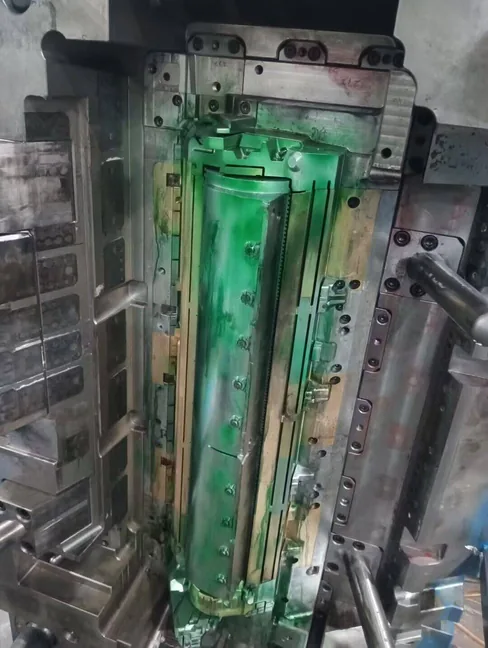
1. Which Appliance Part Are You Making?
You can place your part in one of four groups, and each asks something different from the mold.
Table 1 · Four appliance groups
| Group | What it asks of the tool | Where it fails |
|---|---|---|
| Refrigerator liners | Deep-draw flow, even cooling, large tonnage | Flange warpage that fights the foaming fixture |
| Door / cosmetic panels | Gloss, paint-free surface, sink-mark control | Sink behind ribs, gloss variation across cavities |
| Washing machine, air conditioner | Sealing surfaces, assembly interfaces, structure | Leaks, fit-up gaps, stressed assembly |
| Vacuum cleaner, small appliance | Mid-size, appearance plus wear on sliding faces | Worn slides showing as rattle and cosmetic damage |
Refrigerator liners are large, thin and deep-drawn — the hardest group. Door panels and cosmetic panels are about gloss, paint-free surfaces and sink marks. Washing machine and air conditioner parts are structural, with sealing surfaces and assembly interfaces. Vacuum cleaner and small appliance parts are mid-sized, with appearance and wear requirements. We quote a plastic injection mold for refrigerator project, a plastic injection mold of washing machine project, or a vacuum cleaner plastic injection mold project only after we know which group you are in.
We will start with the liner, because it tests large-mold design hardest.
2. Refrigerator Liners: Large, Thin and Deep-Drawn
A liner is a deep-draw flow problem. You should give us the liner 3D, the wall-thickness map and the annual volume, because draw depth and wall thickness decide gate position, cooling layout and machine tonnage more than the overall size does.
When we design a refrigerator plastic injection mold for a liner, we balance flow across the deep draw and design cooling so the core and cavity remove heat evenly. Uneven cooling in a liner shows up as warpage at the flange, which then fights the foaming fixture. A custom injection refrigerator plastic mold design project starts with this flow and cooling analysis, not with a steel order. If you are comparing a design refrigerator plastic injection mold proposal from several suppliers, ask each one for the fill and cooling analysis — not just the drawing.
Liners are a forming problem; door panels are an appearance problem.
3. Door Panels and Cosmetic Requirements: Gloss, Paint-Free and Sink Marks
A door panel is judged by the eye, so we treat the cosmetic standard as a hard input. You should give us a gloss target, a texture number, and a clear definition of which surfaces are A-side. A high quality refrigerator plastic injection mold for a visible panel is built around that definition, and a high precision refrigerator plastic injection mold is what holds it over a long production run.
Paint-free and high-gloss panels need higher mold temperature and a finer polish, and the steel has to hold that polish. Sink marks behind ribs are a mold-side and process-side problem together: we adjust rib thickness and gate location in design, and packing pressure in the process. When you evaluate a precision refrigerator plastic injection mold quote, ask how the supplier controls sink marks — if the answer is only "we will try," that is not a control plan.
Appearance parts sit alongside structural parts, and those have their own demands.
4. Washing Machine, Air Conditioner and Vacuum Cleaner Parts: Structural Shells
Structural appliance parts are about sealing surfaces and assembly interfaces. We build plastic injection mold of washing machine tools, including plastic injection mold of washing machine factory production and customized plastic injection mold of washing machine projects, and we quote them from the sealing geometry rather than from the outline size.
Air conditioner and TV shells combine size with appearance, so they carry the same cosmetic rules as door panels plus the tonnage rules of a large tool. A vacuum cleaner plastic injection mold project is usually mid-sized, but it still needs wear control on sliding surfaces and a clear vacuum cleaner plastic injection mold production process from design to tryout. When a customer asks about a vacuum cleaner plastic injection mold for sale, we quote the tool and the process together, because the wear life depends on both.
All of these parts share one thing: they are large, which brings us to tonnage.
5. Tonnage and Machine Size for Large Molds
You must confirm that the mold fits your press before you approve the design. We calculate clamping force from projected area, check the mold's dimensional envelope against your platen and tie-bar spacing, and check shot size against your injection unit. This is standard practice for a large injection mold, and it is where many appliance projects fail late.
Table 2 · Three checks before design approval
| Check | Measured against | Failure if skipped |
|---|---|---|
| Clamping force | Projected area × cavity pressure | Flash at the parting line that no process setting can fix |
| Mold envelope | Platen size and tie-bar spacing | Mold simply does not go into the press |
| Shot size | Injection unit capacity and plasticising rate | Short shots, long recovery, cycle time that will not hold |
Our guide to injection-molding-machine-tonnage covers the calculation in detail. You should send us your press specification with the RFQ, and we will confirm fit before quoting.
Fitting the press is only half of it — the mold also has to work with the foaming fixture.
6. Foaming Fixtures and Assembly Interfaces
A refrigerator liner does not stand alone; it mates with the cabinet and is held by a foaming fixture. We design the mold's flange and locating features to match the fixture, and we coordinate the interface between the mold supplier and the fixture supplier so nobody blames the other at assembly.
You should confirm three things before tooling: the locating datum, the flange tolerance, and who owns the fixture design. Getting these wrong shows up as gaps and foam leaks, not as mold defects — which makes them expensive to trace.
Once assembly is settled, the final judge is the surface.
7. Surface Quality on Visible Appliance Parts: Gloss, Paint-Free and Sink Marks
Surface quality on visible appliance parts is a specification, not an opinion. You should define A-side and B-side, set a gloss range, and approve a texture plaque before steel is cut. We control gloss consistency by etching after final polishing and by checking first samples against your plaque.
Paint-free surfaces are the hardest, because there is no coating to hide flow marks or weld lines. We set steel grade, polish grade and mold temperature together for these parts, and we treat sink marks as a design and process problem rather than a polishing problem.
High gloss is three numbers, not one word. The mold temperature it runs at, the steel it is polished in, and the polish grade the surface reaches. A page that says "mirror finish" without those three has described a photograph, not a tool.
Surface quality depends on design, and it also depends on process discipline.
8. Custom Process: OEM, ODM, Design and Manufacturing
A custom injection refrigerator plastic mold project runs through five stages: DFM review, mold design, machining, tryout and acceptance. We offer both oem and odm models — under OEM you own the design and we build to it; under ODM we develop the mold design with you from the part requirement.
Table 3 · OEM against ODM
| Model | Who owns the design | Best when |
|---|---|---|
| OEM | You own the part and mold design; we build to your drawing | Your engineering team has the CAD and the approval chain |
| ODM | We develop the mold design with you from the part requirement | You have the product concept but not the tooling detail |
Our refrigerator plastic injection mold manufacturing process documents each stage, and our refrigerator plastic injection mold technology choices — steel, runner, cooling — are recorded so your maintenance team can reference them later. If you want a refrigerator plastic injection mold design service, we start with the DFM report, because that is where most cost and risk are decided.
Once the mold is accepted, the real work begins: keeping it running.
9. Maintenance and Life: Making a Large Mold Last
A large mold is an asset you keep for years, so maintain refrigerator plastic injection mold discipline matters from day one. Maintenance of refrigerator plastic injection mold includes rust prevention on the large parting surfaces, water-line descaling, lifting-point inspection, and correct storage.
To extend refrigerator plastic injection mold s life, you should track shot count against the rating and service the mold on a schedule rather than on failure. The wear of vacuum cleaner plastic injection mold sliding surfaces follows the same logic — wear is managed, not discovered. Our guide to mold-cleaning-maintenance gives you the checklist.
- Large parting surfaces. Rust here is dimensional, not cosmetic — it shows up as flash across a meter of panel.
- Lifting points. Inspected on a schedule; a large mold dropped once ends its life.
- Shot count against rating. Service at the planned interval, before the drift appears in the parts.
With the mold running, the last question is how we work together.
10. How We Work With You
Send us your 3D files, your cosmetic standard and your annual volume. We will return a quote within 48 hours that states tonnage, cavity count, steel and polish grade, so you can compare a refrigerator plastic injection mold price from us against other suppliers on equal terms.
We supply appliance molds for customers who need a refrigerator plastic injection mold for sale, a refrigerator plastic injection mold supply program, or a specialized refrigerator plastic injection mold built around one part family. If you want to see how we handle large panels and foaming interfaces before you commit, we welcome a factory visit and can send sample parts from comparable projects.
Tell us which of the four appliance groups you are in, and we will tell you exactly what the tool needs.
Send the 3D file, the cosmetic standard, the volume. You get a 48-hour quote naming the tonnage, cavity count, steel and polish grade — and a press-fit confirmation against your platen and shot capacity before design approval.
Start the quote on WhatsApp (+86 191 1290 5173) or email 877657530@qq.com
All 34 pages in this injection mold guide
Foundations and design
- Hub: types, structure, companies
- Mold types, pros and cons
- Design service and workflow
- Mold flow analysis and 3D design
- Gate, runner, cooling, ejection
- Mold steel, aluminum and copper
- Commodity plastics: PP, ABS, PC
- Engineering plastics: PA, POM, PBT
Cost and delivery
- Cost breakdown
- Price range, quote, lead time
- Prototype, low volume, mass production
- Quality, class, defects, safety
- Cleaning, maintenance, repair
- Custom mold: drawing to T1
- Machine tonnage and fit
Sourcing and supply
- Tooling service: CNC, EDM, tryout
- Manufacturers and maker directory
- Factory layout and audit
- Suppliers, exporters and verification
- China supply, price, export
- China OEM / ODM process
By industry
Talk to the factory
WhatsApp and email reach the same team that cuts the steel, not a trading desk. Send the 3D file, the annual volume and the resin grade, and you get a quote with cavity count, steel and lead time.
- WhatsApp: +86 191 1290 5173
- Email: 877657530@qq.com
- Mold catalogue in English: Injection molds built in Chongqing · Catálogo en español