




Cup, Cutlery and Food Container Injection Molds
We build plastic cup injection mold, cutlery mold and thin wall container mold tooling for the parts that serve food every day: thin-wall cups, cutlery, food containers and lids. Three things decide whether these tools make money — cycle time and wall control, stack-mold output, and food-contact compliance. This page explains how we design around each, and how you can check a supplier before you commit. Send us your 3D files, annual volume and food-contact standard, and we will return a quote within 48 hours with a cavity and stack-mold proposal.
| Part families | Cup · cutlery · container · lid |
|---|---|
| Cup judged on | Wall at production cycle |
| Cutlery judged on | Stack output per cycle |
| Container judged on | Lid seal tolerance |
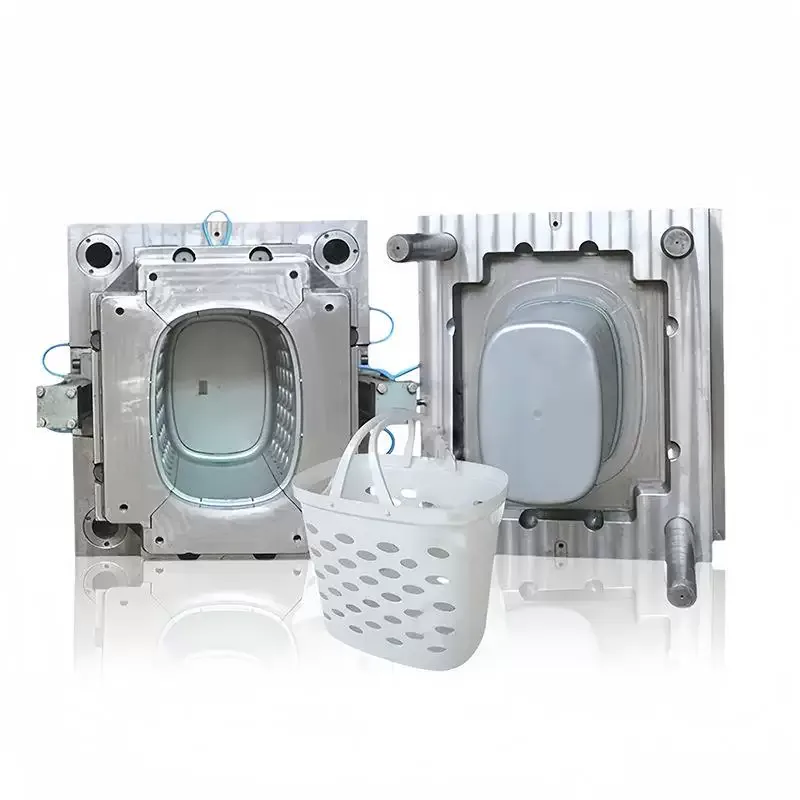
1. Thin-Wall Cups: Cycle Time, Wall Control and Flatness at Speed
A thin-wall cup is a cycle-time problem and a wall-control problem at the same time. You should give us the wall thickness, the cup geometry, the annual volume and the stack height, because those four decide cavity count, stack-mold layout and cooling design.
Table 1 · Where a thin-wall cup drifts at production speed
| Dimension | What drifts | Control in the tool |
|---|---|---|
| Wall thickness | Thins toward the base of the draw as fill speed rises | Gate at the base centre, delivery sized for the fill rate |
| Base flatness | Sags when the base cools before the wall | Separate core circuit, ejection at an even temperature |
| Rim roundness | Ovals and trim marks at high shot counts | Balanced fill and rim cooling; trim allowance in the cavity |
| Cycle time | Creeps up as circuits foul and water temperature wanders | Flow rate and baffle design; water temperature held per zone |
When we build a plastic cup injection mold, we design cooling into the core so the wall solidifies evenly at speed. Holding wall thickness and base flatness at high cycle rates is where most rigid injection mold plastic cups projects fail — the cup looks right at tryout and drifts out of tolerance at production speed. An injection mold for plastic cups built without that cooling control will hit the cycle target on paper and miss it on the press.
If you are comparing plastic cup injection mold manufacturers, plastic cup injection mold supplier or plastic cup injection mold suppliers quotes, ask each one for the wall-thickness study at production cycle. Our plastic cup injection mold company team and our plastic cup injection mold factories programs quote from that study, and an example plastic cup injection mold study report is available on request so you can see the format before you commit.
Cups are a wall-control problem; cutlery is an output problem.
2. Cutlery: Stack Molds and High Output
Cutlery rewards stack molds and high output, but stack height is a trade against mold size, tonnage and maintenance. A plastic spoon injection mold or a plastic injection spoon mold usually runs a stack layout, and each stack level adds output without adding floor space.
Table 2 · The stack ladder for a spoon or fork tool
| Stack levels | Output per cycle | What each level demands |
|---|---|---|
| 1 | One face of parts | Standard tonnage and shut height; standard maintenance access |
| 2 | Double | Taller mold, higher clamp force, cooling split across both faces |
| 4 | Quadruple | Dedicated press, clamp and shut-height match, planned maintenance window |
We build injection mold plastic spoon, injection plastic spoon mold and plastic spoon injection mold tools with balanced cooling across stack levels, and we match the plastic spoon mold injection machine to your press before quoting. A stack mold that does not fit your tonnage is a stack mold you cannot run.
We also serve buyers sourcing from specific markets. If you need a china injection mold plastic spoon, a china injection plastic spoon mold or a china plastic injection spoon mold, we quote the same way. And if you are searching for an injection plastic spoon mold in guyana, an injection plastic spoon mold in kyrgyzstan, an injection plastic spoon mold in laos, an injection plastic spoon mold in paraguay or a plastic spoon injection mold in tanzania, we ship and support tooling to those markets and can share references from comparable projects.
High output is a stack question, not a cavity question. A spoon or fork tool gains output by stacking cavities in the same platen, which changes tonnage and shut height before it changes the cycle. Quote the stack against your press, not against the catalogue.
Cutlery is an output problem; containers are a sealing problem.
3. Food Containers and Lids: Sealing Tolerance
A food container is judged by its lid, and the lid is a sealing-tolerance problem. You should give us the container geometry, the lid interface, the stack load and the closure type, because those decide the sealing rib design and the mold's dimensional control.
We build food container and lid tools as a matched pair, so the sealing rib and the lid skirt are designed together rather than separately. A container that seals at tryout but leaks after shipping usually has a lid-tolerance problem, not a container problem. We confirm the sealing dimension against your closure test before acceptance.
- Sealing rib compression. Set as a band, not a single value, so the seal holds across the full tolerance stack.
- Container rim flatness. Measured after cooling, because a rim that is flat hot and warped cold leaks in the truck.
- Lid skirt fit. Designed against the same cavity that moulds the rim, so the pair is matched at the steel, not at the assembly line.
- Closure test after shipping. A vibration and stack test tells you more about the seal than a tryout room ever will.
Sealing is a tolerance problem; food contact is a compliance problem.
4. Food Contact Materials and Compliance
Food-contact compliance is a documentation problem as much as a material problem. You should tell us the resin, the service temperature and the food-contact standard you must meet, because those decide both the material and the steel.
For an injection mold print food grade plastic project, we document the material certificate and the process window so your compliance file is complete. We also confirm that the mold's cleaning and release agents are food-contact compatible, because a compliant resin in a non-compliant mold is not compliant.
- Resin certificate. The grade, the supplier and the food-contact declaration kept with the tool record.
- Service temperature. Hot fill, microwave or chilled use, stated before the steel is chosen.
- Standard named. The food-contact standard written into the quote instead of assumed.
- Release agent. Food-contact compatible, or the compliant resin stops being compliant at the first cycle.
- Cleaning chemistry. Cleaning agents that suit the cavity surface, so upkeep does not degrade the part.
Compliance is settled before decoration, which brings us to IML.
5. In-Mold Labeling and Decoration Interfaces
An in-mold labeling and decoration interfaces decide how your product looks on the shelf. An IML tool needs a label-retention design, a vacuum or electrostatic system, and a gate position that does not disturb the label.
- Label retention. Vacuum ports or an electrostatic charge decided with the label thickness, not after the tool is cut.
- Gate position. Placed so the flow does not shift the label or leave a witness mark on the decorated face.
- Insert handling. A robot or manual pick-up that fits the cycle time you are quoting.
- Decoration standard. The label material and finish agreed with your artwork before the cavity is polished.
We build IML buckets and food containers with the decoration interface designed into the tool, not added afterward. You should give us the label material and the decoration standard, because the label and the tool have to be designed together. A tool built for unlabeled parts rarely accepts labels without modification.
Decoration is one variable; seasonality is another.
6. Tooling for a Seasonal SKU Range
A seasonal SKU range means many designs and short runs, and that changes the tooling question. You should decide whether to invest in steel for every SKU or to use a family tool or a modular insert system. We help customers map SKU count against annual volume so the tooling budget follows the demand, not the catalog.
Table 3 · Three tooling strategies for a seasonal range
| Strategy | Best when | What you pay for |
|---|---|---|
| Dedicated mold per SKU | Each design runs long enough to amortise its own tool | Many tools, highest total spend, simplest changeover |
| Family tool | SKUs share wall thickness, resin and envelope and differ in shape | One base with several cavities, changeover by cavity |
| Modular inserts | Designs change every season but the container envelope is fixed | One base plus an insert set per season, fastest swap |
Seasonal tooling budget
dedicated = SKUs × tool costfamily = base tool + cavities × cavity cost
Compare cost per SKU per season, not per tool
For a seasonal range, a family tool or interchangeable inserts often beat a dedicated mold per SKU. We quote both options so you can compare total cost rather than mold price.
Once the tooling strategy is set, the last question is how you buy.
7. How We Work With You
Send us your 3D files, your annual volume and your food-contact standard. We will return a quote within 48 hours that states cavity count, stack height, steel and cycle target, so you can compare suppliers on equal terms.
We build plastic cup injection mold, plastic spoon injection mold and thin wall container mold programs for customers worldwide, including buyers searching for an injection plastic spoon mold in guyana, an injection plastic spoon mold in kyrgyzstan, an injection plastic spoon mold in laos, an injection plastic spoon mold in paraguay or a plastic spoon injection mold in tanzania. If you want to compare tooling cost against piece cost, our guide to plastic-injection-mold-cost shows you the math.
Tell us which product you are making, and we will tell you exactly what the tool needs.
Send the 3D, the volume, the food-contact standard. You get a 48-hour quote stating cavity count, stack height, steel and cycle target — with the wall-thickness study and material certificate attached.
Start the quote on WhatsApp (+86 191 1290 5173) or email 877657530@qq.com
All 34 pages in this injection mold guide
Foundations and design
- Hub: types, structure, companies
- Mold types, pros and cons
- Design service and workflow
- Mold flow analysis and 3D design
- Gate, runner, cooling, ejection
- Mold steel, aluminum and copper
- Commodity plastics: PP, ABS, PC
- Engineering plastics: PA, POM, PBT
Cost and delivery
- Cost breakdown
- Price range, quote, lead time
- Prototype, low volume, mass production
- Quality, class, defects, safety
- Cleaning, maintenance, repair
- Custom mold: drawing to T1
Sourcing and supply
- Tooling service: CNC, EDM, tryout
- Manufacturers and maker directory
- Factory layout and audit
- Suppliers, exporters and verification
- China supply, price, export
- China OEM / ODM process
By industry
Talk to the factory
WhatsApp and email reach the same team that cuts the steel, not a trading desk. Send the 3D file, the annual volume and the resin grade, and you get a quote with cavity count, steel and lead time.
- WhatsApp: +86 191 1290 5173
- Email: 877657530@qq.com
- Mold catalogue in English: Injection molds built in Chongqing · Catálogo en español