




Small Appliance and Houseware Injection Molds
We build houseware plastic injection mold and kitchenware plastic injection mold for the parts people use every day: kitchen tools, juicer and blender components, fans, bins, storage boxes and small appliance housings. Three things decide whether these tools make money — food-contact compliance, transparent-resin quality, and cycle time at high cavity counts. This page explains how we design around each, and how you can check a supplier before you commit.
| Part groups | Four, four cost drivers |
|---|---|
| Kitchenware | Food contact, heat, washing |
| Transparent | PC · PMMA · Tritan |
| Cycle share | Cooling is the largest |
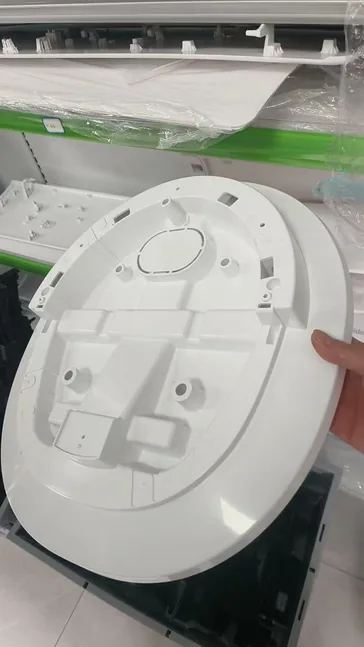
1. Which Houseware Part Are You Making?
You can place your part in one of four groups. Kitchenware is about food contact, heat resistance and dishwasher durability. Juicer and blender parts are about transparent resins and optics. Fans, bins and storage are about multi-cavity layout and cycle time. Small appliance housings are about appearance and wear.
Table 1 · Four houseware groups
| Group | Driven by | Where money is lost |
|---|---|---|
| Kitchenware | Food contact, heat resistance, dishwasher durability | Non-compliant resin, stress cracking in hot water |
| Juicer / blender parts | Transparent resins and optics | Flow marks, weld lines, crazing weeks after molding |
| Fans, bins, storage | Multi-cavity layout and cycle time | Deep cores without cooling; cycle never hits target |
| Small appliance housings | Appearance and wear | Gloss variation, worn sliding faces |
We quote a household products plastic injection mold project, an appliance parts plastic injection mold project, or a household plastic injection mold components rapid injection molded parts oem program only after we know which group you are in, because cavity count, steel and cooling all follow from that answer.
We will start with kitchenware, because it carries the strictest compliance.
2. Kitchenware: Food Contact and Heat Resistance
Kitchenware is a compliance problem before it is a molding problem. You should give us the resin grade, the maximum service temperature, and the food-contact standard you must meet, because those three decide both the material and the steel.
For a kitchenware plastic injection mold or a kitchen ware plastic injection mold, we select steel and polish that resist the detergents and heat of dishwasher cycles, and we document the material certificate so your compliance file is complete. Heat resistance is a material choice, but it is also a cooling choice — parts that are cooled too fast carry internal stress and fail in hot water.
Heat resistance is two decisions, not one. The resin sets the ceiling; the cooling design decides whether the part actually survives a dishwasher cycle without stress cracking.
Kitchenware is about compliance; transparent parts are about optics.
3. Juicers and Blender Parts: Transparent Resins
Transparent parts punish every mistake. PC, PMMA and Tritan all flow differently, and each one shows flow marks, weld lines and stress crazing if the tool is not designed for it. When we build a juicer plastic injection mold, we set gate location, polish grade and cooling together, because a transparent part is judged on clarity, not just on dimensions.
Table 2 · Three transparent resins
| Resin | What it punishes | Design response |
|---|---|---|
| PC | High melt temperature; stress crazing at packed gates | Generous gate, slow pack, high mold temperature |
| PMMA | Brittleness and weld lines that read as cracks | Gate away from the visible face; weld line placed in a hidden zone |
| Tritan | Drying-sensitive; moisture shows as silver streaks | Dryer discipline written into the process sheet, verified at tryout |
You should tell us your transparency standard and whether you require a stress test, because stress cracking in a transparent part often appears weeks after molding, not at tryout. We design for that by controlling packing and cooling rather than by polishing harder.
Transparent parts are a quality problem; bins and storage are a productivity problem.
4. Fans, Bins and Storage: Multi-Cavity Layouts and Cavity Count Against Cycle Time
Bins, storage boxes and fan parts reward multi-cavity layouts, but cavity count is a trade against cycle time. You should evaluate the two together, not pick a cavity number from a catalog. A plastic injection dustbin mold or a dustbin mould plastic injection mold with deep cavities needs cooling designed into the core, or the cycle stretches and the savings disappear.
A houseware plastic injection mold for storage items usually runs higher cavity counts than a kitchen tool, so we balance the runner and design ejection so parts drop cleanly at speed. You should tell us your target cycle time before we quote, because it changes the cooling design.
Multi-cavity is how you hit a cycle target, so let us talk about the target itself.
5. Cycle Time Targets for High-Volume Houseware
Cycle time breaks into injection, packing, cooling, and mold open-close. Cooling is almost always the largest share, and it is where we focus when a customer sets a cycle time target for high volume houseware.
Table 3 · Where the cycle goes
| Phase | Share | Lever |
|---|---|---|
| Injection | Short, but sets everything else | Gate size, fill rate, melt temperature |
| Packing | Short | Hold pressure and time needed for the thickest section |
| Cooling | Largest share | Circuit layout, baffles in deep cores, turbulent flow |
| Open-close | Fixed | Robot and ejection design, not the mold alone |
You should write the cycle target into the contract, measured on an agreed machine and material, so that "fast" becomes a number both sides accept. A mold that hits the target on the supplier's press but not on yours is not a passed mold.
The four numbers a houseware buyer checks. How many cavities, cycle time in seconds, shot life, and how fast a colour or resin change runs. Unit price is built from those four, not from how the mold looks.
Cycle time is one lever; color changes and family molds are another.
6. Color Change, Family Molds and the Seasonal Tooling Budget
Color change and family molds decide how flexible your tool is. A household multi material plastic injection mold or a household wearresistant multi material plastic injection mold lets you combine materials or add a wear layer, but it also makes color changes slower. You should plan color-change cleaning into the maintenance schedule, not discover it at the first changeover.
Family molds save tooling cost by combining parts, but they complicate validation and color control. For seasonal products, the tooling budget question is whether to invest in steel at all — a bridge or soft tool often makes more sense, and our guide to prototype-low-volume-mass-production walks through that decision.
Once the tool strategy is settled, the next step is working with us.
7. How We Work With You
Send us your 3D files, your material and your annual volume. We will return a quote within 48 hours that states cavity count, steel, polish grade and cycle target, so you can compare suppliers on equal terms.
We work with household products plastic injection mold factory, household products plastic injection mold manufacturer and household products plastic injection mold supplier partners, and we run household plastic injection mold wholesale factory programs for distributors. We also build appliance parts plastic injection transfer mold projects, hair dryer plastic injection mold tools, and kitchenware, juicer, dustbin and storage tools for customers who need a single source. If you want to compare tooling cost against piece cost, our guide to plastic-injection-mold-cost shows you the math.
Tell us which of the four houseware groups you are in, and we will tell you exactly what the tool needs.
Send the 3D file, the material, the volume. You get a 48-hour quote naming the cavity count, steel, polish grade and a cycle target measured on an agreed machine — plus the compliance documents your kitchenware file needs.
Start the quote on WhatsApp (+86 191 1290 5173) or email 877657530@qq.com
All 34 pages in this injection mold guide
Foundations and design
- Hub: types, structure, companies
- Mold types, pros and cons
- Design service and workflow
- Mold flow analysis and 3D design
- Gate, runner, cooling, ejection
- Mold steel, aluminum and copper
- Commodity plastics: PP, ABS, PC
- Engineering plastics: PA, POM, PBT
Cost and delivery
- Cost breakdown
- Price range, quote, lead time
- Prototype, low volume, mass production
- Quality, class, defects, safety
- Cleaning, maintenance, repair
- Custom mold: drawing to T1
Sourcing and supply
- Tooling service: CNC, EDM, tryout
- Manufacturers and maker directory
- Factory layout and audit
- Suppliers, exporters and verification
- China supply, price, export
- China OEM / ODM process
By industry
Talk to the factory
WhatsApp and email reach the same team that cuts the steel, not a trading desk. Send the 3D file, the annual volume and the resin grade, and you get a quote with cavity count, steel and lead time.
- WhatsApp: +86 191 1290 5173
- Email: 877657530@qq.com
- Mold catalogue in English: Injection molds built in Chongqing · Catálogo en español