




Mold Tooling Service: CNC, EDM, Fabrication and Tryout
Plastic injection mold tooling is the chain of machining, finishing and tryout steps that turns a steel block into a working mold. Every step in the chain has a tolerance, an inspection point, and a cost — and skipping or rushing any of them shows up later as flash, mismatch, or a tool that needs rework before it ever runs a production shot. This page walks through our plastic injection mold making process from saw to tryout, explains what each step contributes, and helps you decide whether to build in-house or outsource. For the design side of the tool, start with our plastic injection mold hub page .
| Chain length | 11 steps, saw to tryout |
|---|---|
| Mating tolerance | ±0.02 mm cavity / core |
| Shutoff tolerance | ±0.01 mm |
| In-house | CNC, EDM, wire, grind, polish, fit, tryout |
1. Tooling Flow from Steel Block to Assembled Mold
Our plastic injection mold fabrication flow follows ten steps: saw, rough machine, heat treat, CNC, deep-hole drilling, wire EDM, EDM, grind, polish, fit, and tryout. Ten-step chain: saw, rough, heat treat, CNC, deep hole, wire EDM, EDM, grind, polish, fit, tryout is the sequence we follow for every tool, and each step has a purpose.
- 01 · Saw
- 02 · Rough machine
- 03 · Heat treat
- 04 · CNC
- 05 · Deep-hole drilling
- 06 · Wire EDM
- 07 · Sinker EDM
- 08 · Grind
- 09 · Polish
- 10 · Fit
- 11 · Tryout
Saw and rough machine cut the steel block to oversize, leaving stock for heat treatment distortion. Heat treat brings the steel to its working hardness; pre-hardened grades (P20, 718) skip this step, which is one reason they are faster to build. CNC cuts the cavity and core to near-final geometry. Deep-hole drilling opens cooling channels. Wire EDM cuts hardened steel and sharp internal corners. EDM produces fine detail and deep ribs that a cutter cannot reach. Grind brings mating surfaces to final flatness. Polish sets the surface finish. Fit assembles the mold and checks shutoffs. Tryout proves the tool on a press.
A plastic injection mold tooling service that skips the rough-and-heat-treat sequence for a hardened tool will distort the cavity in heat treatment and spend the savings on rework. Injection mold fabrication is a sequence, not a set of independent operations.
Order is the quality control. Heat treat after final machining means distortion lands on finished surfaces. Rough first, leave stock, harden, then finish — every shortcut here is paid for twice, once in rework and once in schedule.
The sequence is the same everywhere; the split is not. Blank, rough mill, heat treat, finish mill, deep-hole drill, wire cut, EDM, grind, polish, fit, tryout. What differs is the in-house rate and the inspection point: which steps are subcontracted, and which step must be measured before the next one starts. That split is what a lead time is actually made of.
2. CNC Roughing and Finishing: Tolerances That Matter
CNC is where the cavity and core take shape, and cnc mold plastic injection work splits into roughing and finishing.
Roughing removes most of the material quickly, leaving 0.3–0.5 mm of stock for finishing. Roughing feeds and speeds are set for material removal rate, not surface finish. Precision machining plastic injection mold work starts with a stable roughing operation — if the roughing leaves uneven stock, the finishing cutter will deflect and the tolerance will drift.
Finishing cuts to final dimension. The tolerances that matter are: cavity and core matching (typically ±0.02 mm), shutoff surfaces (±0.01 mm), and parting-line flatness. High precision plastic injection mold manufacturing means the finishing operation is planned around the features that must match, not around the whole surface.
Table 1 · Tolerances by feature type
| Feature | Typical tolerance | Why it is held that tight |
|---|---|---|
| Shutoff surfaces | ±0.01 mm | Any gap flashes; any interference galls |
| Cavity / core matching | ±0.02 mm | Wall thickness variation and mismatch line |
| Parting-line flatness | Full contact over the whole face | Uneven contact builds tonnage unevenly and flashes |
| Mating surfaces on small housings | ±0.02 mm | Assembly fit and shutoff contact |
| Non-mating dimensions | ±0.05 mm | Tighter adds cost without adding function |
Plastic injection mold machining for deep ribs and thin walls needs a smaller cutter, which deflects more; we reduce step-over and use a finishing pass at low feed to hold the tolerance. Standard plastic injection mold tooling tolerances for small plastic housings are usually ±0.05 mm on non-mating dimensions and ±0.02 mm on mating surfaces — tighter than that adds cost without adding function.
3. EDM, Wire Cut and Grinding for Deep Ribs
EDM and wire cut are the processes that reach where a rotating cutter cannot.
Wire EDM cuts hardened steel with a wire electrode, producing sharp internal corners and precise shutoffs. It is the standard way to cut slider pockets, insert pockets, and parting-line details after heat treatment. Sinker EDM machine for plastic injection mold work (die-sinking EDM) burns cavities with a shaped electrode, which is how deep ribs, sharp text, and fine texture details are produced.
Grinding brings mating surfaces to final flatness and parallelism. A mold base that is not ground flat will not build clamp tonnage evenly, and the parting line will flash.
Injection mold plastic tooling for deep ribs often uses EDM because the rib depth-to-width ratio makes CNC finishing impractical. Plastic injection mold tool design should account for EDM: sharp internal corners need a wire start hole, and deep ribs need electrode access.
4. Polishing, Texture and Final Assembly
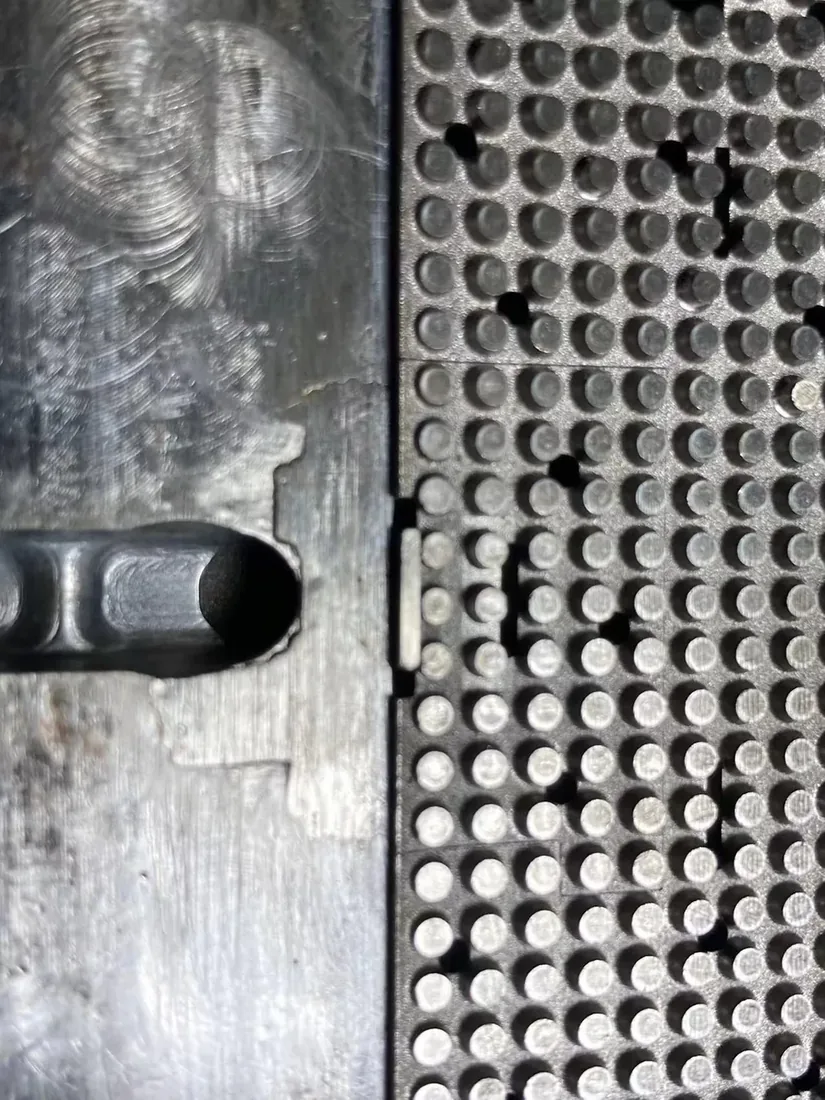
Polishing sets the surface finish and, for transparent or cosmetic parts, the optical quality. Plastic injection mold tooling close up inspection shows whether the polish is uniform — a polished cavity with swirl marks will produce hazy parts.
Texture is applied by acid etching or laser. Plastic injection mold tool design must specify the texture depth and the draft angle that goes with it; a texture applied to a low-draft wall will drag on ejection.
Final assembly fits the cavity, core, sliders, ejector system, and hot runner (if used) into the base. Plastic injection mold tools are assembled with the same care as they are machined — a slider that binds or a shutoff that mismatches will show up as flash or galling on the first trial.
Draft before texture, not after. Etching deepens the walls it touches and tightens release. A wall cut at 1° and then etched at 0.05 mm depth has effectively less draft than the drawing says — check the draft with the texture allowance included.
5. The Inspection Point After Each Step
In-house ratio and the inspection point after each step is how we control quality: every step has a check before the next step begins.
Table 2 · Step, inspection point and the failure it prevents
| Step | Inspection | Failure it prevents |
|---|---|---|
| Saw / rough | Dimensions and stock allowance | No stock left for heat treat distortion |
| Heat treat | Hardness and distortion | Soft cavity, or a block that is no longer square |
| CNC rough | Stock uniformity | Cutter deflection and tolerance drift in finishing |
| CNC finish | Cavity / core dimensions and matching | Mismatch line and wall-thickness variation |
| Wire EDM | Shutoff fit | Flash at the shutoff, galling on opening |
| Sinker EDM | Detail depth and surface | Shallow ribs, burnt skin, wrong texture depth |
| Grind | Flatness and parallelism | Uneven clamp load and parting-line flash |
| Polish | Surface finish and uniformity | Haze, drag marks, visible polishing direction |
| Fit | Shutoff contact and slider movement | Binding slides, mismatch, galling on trial |
| Tryout | Part dimensions and appearance | Shipping a tool that cannot make a good part |
The in-house ratio is the share of steps we perform ourselves versus outsource. We keep CNC, EDM, wire cut, grinding, polishing, fit and tryout in-house; saw and rough machining may be outsourced for large blocks. A plastic injection mold making shop that outsources finishing loses control of the tolerances that matter most. Plastic injection mold manufacturing features that you should ask about: which steps are in-house, what inspection equipment is used, and what happens when a step fails.
6. Tryout, Sampling and Correction Loops
Tryout is where the tool meets the press. We mount the mold, run a shot series, and measure the parts against the drawing. Plastic injection mold tooling service tryout includes: first-shot inspection, dimensional report, appearance check, and a correction list.
Correction loops are normal. A tool that needs a gate adjustment, a vent added, or a shutoff touched up on the first tryout is not a failure — it is the process working. What matters is how fast the corrections are made and whether they are documented. Plastic injection mold tool life starts at tryout: a tool that passes tryout with minimal correction will run longer before its first maintenance.
Plastic injection mold tooling service and best plastic injection mold tooling service claims should be judged by the tryout report, not by the sales brochure. Ask for the dimensional report and the correction list from a recent project.
7. Build In-House or Outsource: Cost and Time
Build in-house or outsource: cost and time is a decision that depends on your volume and your engineering capability.
In-house gives you control over schedule and corrections, but requires CNC, EDM, and a tool room — capital and skilled labor that most product companies do not have. Outsource gives you access to capacity and equipment without capital, but you depend on the supplier's schedule and communication.
Plastic injection mold manufacturing service pricing reflects the equipment and the labor. American made plastic injection mold tooling costs more than overseas tooling but shortens the supply chain and simplifies communication. International plastic injection mold manufacturing and plastic injection mold manufacturing in viet nam offer lower labor costs, but you need to plan for shipping, travel, and IP protection. Plastic injection mold transfer tooling (moving an existing tool to a new molder) is a separate service — it involves inspecting the tool, adapting the mounting pattern, and re-qualifying it on the new press.
Manufacturing facility plastic injection mold and manufacturing facility plastic injection mold near lincolnton nc searches reflect buyers who want a regional supplier; the decision criteria are the same regardless of location. Plastic injection mold manufacturing and molding services combined (tooling plus molding under one roof) simplifies the handoff from tool to production. Emamold plastic injection mold manufacturing and plastic injection mold manufacturing service are supplier-specific terms — verify capability with a shop visit or a reference.
8. DIY, Benchtop and Homemade Molds
The how to make a mold question has a real answer, but it depends on what you are trying to achieve.
For learning and prototyping, a benchtop plastic injection mold setup or a homemade plastic injection mold can produce small parts in forgiving resins. How to injection mold plastic at home and how to injection mold plastic guides cover the basics: a small press, a simple two-plate mold, and a low-melt resin. Diy plastic injection mold and diy plastic mold injection projects are a good way to understand gating, cooling, and ejection — but they are not production tools.
Precious plastic injection mold and precious plastic mold injection refer to the Precious Plastic recycling machines, which are shredder/injector setups for recycled plastic, not precision injection molding. Plastic mold injection at home and at home plastic mold injection produce parts with wide tolerances and limited repeatability.
What they cannot do: hold tight tolerances, run engineering resins, or produce multi-cavity tools. How to make a mold for plastic injection at home usually means a simple cavity with no cooling channels and no ejector system — fine for a few parts, not for a production run. Make your own models for plastic injection mold and make your own plastic injection mold projects are learning exercises; making a mold for production requires the ten-step chain above.
Easiest plastic to injection mold is usually PP or PE — low melt temperature, good flow, forgiving shrinkage. Plastic injection mold making for toys and plastic injection mold for power tools are production applications that need real tooling, not home-built molds. Plastic injection mold making pdf and plastic injection mold making tutorial resources are useful for understanding the process, but they do not replace a tool shop.
Plastic injection mold making email and plastic injection mold making service inquiries should include your part drawing, resin, volume, and target date. Plastic parts plastic injection mold making and plastic injection mold making techniques are broad terms — the answer always comes back to the same chain of steps.
9. How We State Precision and Equipment
Precision in three sentences: machine capability, delivered spec, exclusions is how we describe what we can hold. Machine capability is what the equipment can achieve in ideal conditions; delivered spec is what we guarantee on your part; exclusions are the features we cannot hold without a trial (thin walls, deep ribs, tight flatness over large areas).
Equipment list format: type, brand, travel, spindle speed, accuracy is how we present our capability. A typical entry: "CNC machining center, brand, X/Y/Z travel, spindle speed, positioning accuracy." Plastic injection mold manufacturing process transparency means you can see the equipment and the inspection reports, not just the finished tool.
Best plastic injection mold tooling is not a claim — it is a match between your part, your volume, and the tooling chain that produces it. Plastic injection mold manufacturing and plastic injection mold tooling are broad terms; ask for the ten-step chain, the inspection points, and the tryout report, and you will know whether a supplier can deliver.
10. Where to Go Next
If you are ready to quote a tool, send us your 3D model, 2D drawing, resin, volume, and target date — we will return a tooling plan with the steps, the inspection points, and the tryout scope. For the design stage that precedes tooling, see our plastic injection mold design service page; for how the finished tool is specified, see our injection mold steel page. For the full picture of structure, types, companies and buying, return to our plastic injection mold hub page.
Send the 3D and drawing, get the tooling plan. 3D model, 2D drawing, resin grade, annual volume and target date. You get the step sequence, the in-house ratio, the inspection points, and the tryout scope with the correction budget stated up front.
Start the quote on WhatsApp (+86 191 1290 5173) or email 877657530@qq.com
All 34 pages in this injection mold guide
Foundations and design
- Hub: types, structure, companies
- Mold types, pros and cons
- Design service and workflow
- Mold flow analysis and 3D design
- Gate, runner, cooling, ejection
- Mold steel, aluminum and copper
- Commodity plastics: PP, ABS, PC
- Engineering plastics: PA, POM, PBT
- Machine selection and clamp tonnage
Cost and delivery
- Cost breakdown
- Price range, quote, lead time
- Prototype and low volume
- Quality, precision, defects
- Cleaning, maintenance, repair
- Custom mold: drawing to T1
Sourcing and supply
- Manufacturers and maker directory
- Factory layout and audit
- Suppliers and exporters
- China supplier and export
- China custom OEM / ODM
- Import, HS code and duty
By industry
- Medical
- Electronics
- Refrigerator and white goods
- Small appliance and houseware
- Automotive interior and exterior
- Automotive engineering plastics
- Motorcycle plastics
- Packaging, crate, pallet
- Cup, cutlery, container
- Furniture and chair
- Industrial, agricultural, construction
- Machine tonnage and fit
- Product cases: spoon, stopper, cup, sensor
Talk to the factory
WhatsApp and email reach the same team that cuts the steel, not a trading desk. Send the 3D file, the annual volume and the resin grade, and you get a quote with cavity count, steel and lead time.
- WhatsApp: +86 191 1290 5173
- Email: 877657530@qq.com
- Mold catalogue in English: Injection molds built in Chongqing · Catálogo en español